
Fade vs Taper vs Skin Fade: What's the Difference?
A request we often hear in the chair is "fade on the sides, please." But a fade isn't one haircut: where the blend starts, how short it goes and how it meets the top all change the result. Here's how taper, low, mid, high and skin fades differ, who each one suits, and how to describe the one you want.
Quick answer
A fade blends the sides and back from short to long as it moves up the head. A taper does this only at the sideburns and neckline, with less contrast. Low, mid and high describe where the fade starts; a skin fade takes the bottom to bare skin. Face and head shape, hair type and workplace decide which suits you.
What is a fade haircut?
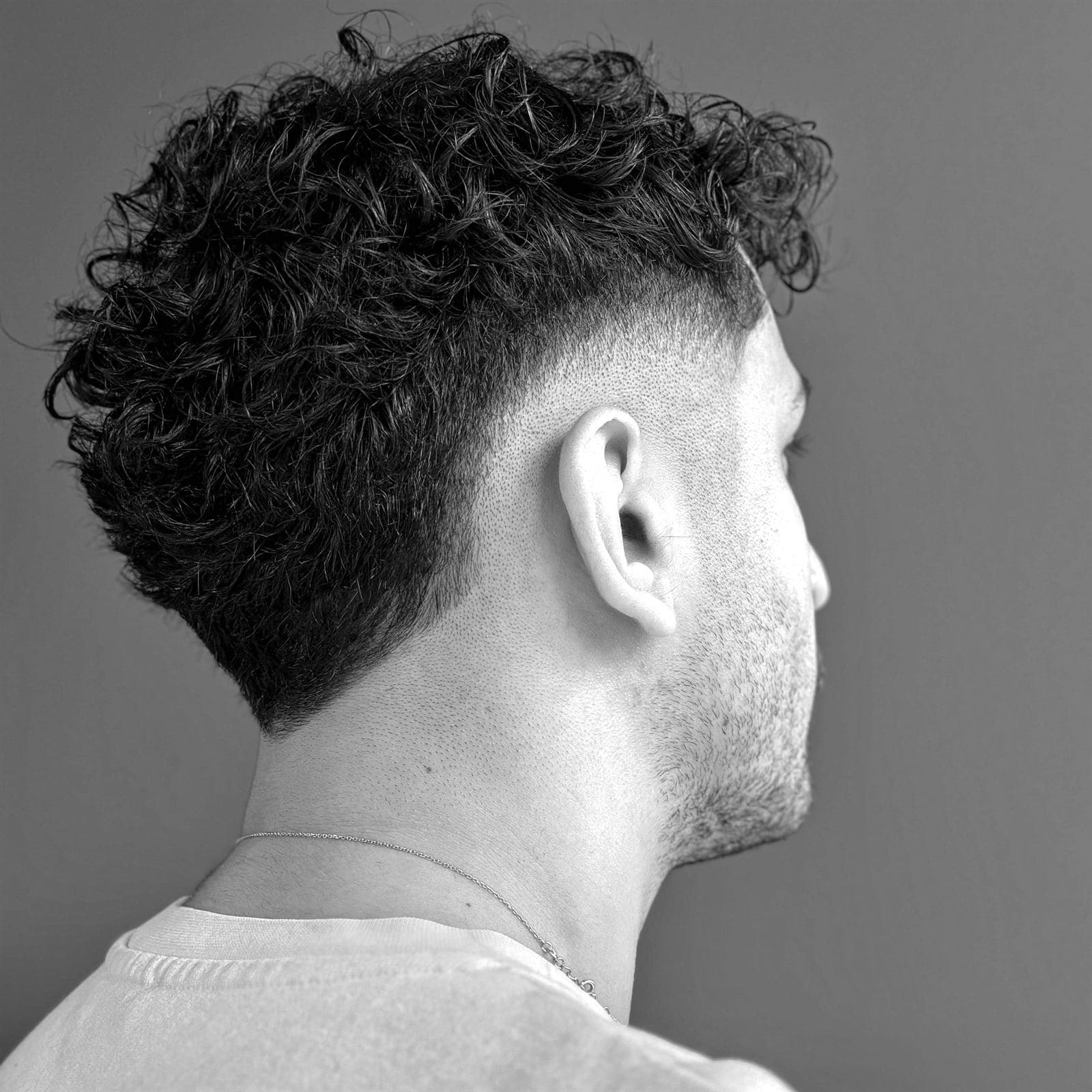
A fade is a cut where the hair on the sides and back gets gradually longer from the bottom up. At the lowest point the hair is very short, sometimes taken down to the skin; as it moves up it lengthens and meets the top without a visible line. That's where the name comes from: the short part fades into the long part.
The blend is what separates a good fade from a poor one. If you can see steps, shadows or a horizontal line between guard lengths, the blend isn't finished. That's why a fade is never a one-guard job: it's built up in layers with several guards, the clipper lever and, in places, scissors and a comb.
A fade is less a style than a technique. On top you might have a French crop, a longer swept-back cut, natural curls or a short buzz, and any of them can be finished with faded sides. The real decision comes down to two questions: where does the blend start, and how short does the bottom go?
What's the difference between a taper and a fade?
A taper also goes from short to long, but it covers far less of the head. It usually sits only at the sideburns and the neckline, and the sides keep most of their length. A fade spreads the blend across a larger part of the sides and back, and usually goes shorter.
The easiest place to see the difference is just above the ear. With a taper, the hair around the ear still looks full; only the edges are cleaned up and thinned out. With a fade, you'll notice the hair getting clearly shorter at or above the top of the ear, often with skin showing through.
In practice there's no hard border between the two. What people call a "taper fade" is an in-between option: the short zone of a taper, brought slightly lower, with a light fade effect at the edges. It's a good starting point if you want a classic look with a neat neckline and sideburns.
Low, mid and high fade: where does the blend start?
Low, mid and high describe the height of a fade, meaning how far up the head the short section climbs. Comparing them on the same terms makes the choice easier: where the blend starts, how much contrast it has with the top, and who it suits.
Low fade: The blend starts just above the ear, close to the natural hairline, and stays low around the back. Contrast is low and most of the sides stay full. It's a safe choice for formal workplaces, for anyone trying a fade for the first time, and for longer faces that don't need extra height.
Mid fade: The blend starts roughly halfway up the sides, between the ear and the temple. Contrast is moderate: clean and noticeable without looking harsh. Because it works with most face shapes and hair types, it's widely seen as the safe middle ground, and it looks just as right at the office as it does at the weekend.
High fade: The blend starts above the temples, near the line where the side of the head curves toward the top. Contrast is high: the sides are very short and the top is clearly longer. It lengthens a round face and adds visual volume on top, but it also exposes any dips or ridges in the head shape. It's a bolder look, so think about your workplace before you commit.
What do skin fade and drop fade mean?
Skin fade (also called a bald fade or zero fade): Here the measure isn't height but depth. The bottom is taken down to the skin with an unguarded clipper, a foil shaver or a razor, then blended upward. It can be low, mid or high, so a "high skin fade" both starts high and goes down to skin. It gives the sharpest contrast of any fade.
A skin fade doesn't look the same on every head. With thick, dark hair the contrast is striking; with fine or light-coloured hair the effect stays softer. Scars, dips or bony ridges on the scalp show directly in the section taken to skin, so it's worth talking about before the clippers come out.
Drop fade: The blend curves down behind the ear toward the nape, so it "drops" as it moves back. From the side it sits higher at the front and lower at the back. Because it follows the natural line of the back of the head, it looks more natural at the neck and can balance a flatter back of the head or an uneven neckline.
Which fade suits you? Face shape, hair type and workplace
Face shape: On round or wide faces, a mid or high fade slims the sides and builds height on top, which makes the face look longer. On long, narrow faces a low fade or taper is more balanced, because leaving some fullness at the sides avoids stretching the face further. Square faces with a strong jaw can carry all three heights comfortably.
Head shape and growth pattern: The face isn't the only thing that decides a cut. If the back of your head is flat, or you have a strong cowlick at the crown, the fade height should be set around that area. The direction your hair grows at the nape also decides whether a drop fade or a straight neckline will look cleaner.
Hair type and colour: Thick, dark, straight hair shows the steps in a fade more, so it needs extra care in the blend. Curly and wavy hair fades very cleanly and brings the texture on top forward. With very fine or thinning hair, taking the sides too short can make the top look sparser, so a low fade or taper is usually more balanced.
Work and daily life: In a formal office, a customer-facing job or a uniformed workplace, a taper or low fade is usually accepted without question. In a more relaxed setting, a mid or high skin fade is no problem. Think about upkeep too: the more contrast a cut has, the sooner it starts to look untidy.
How do you ask your barber for a fade?
"Give me a fade" isn't enough on its own; your barber needs at least three details. First, the height: low, mid or high. Second, how short the bottom goes: down to skin, or leaving a light shadow? Third, the length on top and how much to take off.
Guard numbers are a useful rough guide, not an exact measure. On common professional clipper guards, a #1 is about 3 mm (1/8 inch), a #2 about 6 mm (1/4 inch) and a #3 around 10 mm (3/8 inch), while a "zero" means no guard at all. These values vary by clipper brand and blade setting, so a "number two" in one shop can be a different length in another.
Photos work better than numbers. Show pictures of the cut you like from the front, the side and the back, because a single front photo won't show where the blend starts. Keep in mind your hair may not have the same texture as the person in the photo, and ask your barber how it will actually sit on you.
A few small details are worth settling too: how long the sideburns stay, whether the neckline is squared off or left natural, and whether you want a line-up at the forehead and temples. If you have a beard, agree at the start on how the fade will meet it; the join from sideburn to beard can be blended like a fade of its own.
How does a fade look as it grows out?
A fade changes more than most cuts once it starts growing. The shortest areas change fastest in proportion: 1 mm of hair that grows another 1 mm has doubled in length, while the same growth on 6 cm of hair on top is barely visible. That's why the bottom of the blend is always the first part to lose its shape.
A skin fade softens quickest. Within a few days a shadow appears where the hair was taken to skin, the sharp contrast drops and the blend line starts to blur. On a high fade, as the sides grow in, the difference with the top can turn into a visible step. A mid fade sits between the two: the blend stays readable for a while, then loses its edge once the short area above the ear fills in.
Low fades and tapers grow out more gently. Because most of the hair already keeps its length, the first areas to look untidy are usually the neckline and behind the ears. Tidying just the neckline and sideburns can keep the cut looking sharp for a while. How often you need a full touch-up depends on how fast your hair grows and how crisp you want it, and that's best planned with your barber.
How do we cut a fade at Patron?
At our shop, a fade doesn't start with the clippers. First we look at your facial features, your head shape and the direction your hair grows, and only then decide together where the blend should start and how short the bottom should go. What we call an anatomical cut applies to fades too: the same high fade gives two different results on two different heads.
Fades, tapers, French crops, mullets and buzz cuts are all part of our haircut service. If you'd like the fade planned around your beard, we do hair and beard in a single appointment, so the join from sideburn to beard matches the rest of the cut. The beard is shaped to your facial geometry and finished with an Italian Proraso ritual.
A haircut is 1,100 TL, and hair and beard together is 1,600 TL. Our single shop in Bornova, inside the Folkart Time complex, works by appointment only; you can book on WhatsApp or through the three-step booking wizard on the site. Bring photos of the fade you like, and we'll talk through the rest in the chair.
Frequently Asked
What's the difference between a fade and a taper?
A taper blends from short to long only at the sideburns and neckline, and keeps most of the length on the sides. A fade spreads the blend across more of the sides and back and usually goes shorter, sometimes down to skin.
What's the difference between a low, mid and high fade?
The difference is where the blend starts. A low fade starts just above the ear, a mid fade halfway up the sides and a high fade above the temples; the higher it starts, the stronger the contrast with the top.
Does a skin fade suit everyone?
It doesn't give the same result on every head. Scars, dips or pronounced ridges on the scalp show in the section taken to skin, and with fine or light-coloured hair the contrast is weaker, so talk it through with your barber first.
What clipper guard number should I ask for?
Use numbers only as a rough guide: on common professional guards a #1 is about 3 mm and a #2 about 6 mm, but this varies by clipper brand. The height (low, mid or high), how short the bottom goes and photos from the front, side and back describe the cut far more clearly.
Is a fade appropriate for the office?
A taper or low fade is accepted in most formal workplaces, because the sides stay full and the cut looks neat. High and skin fades are bolder, so it makes sense to match them to your workplace's norms.
Related services
Reading's over — chair awaits
This piece opened a door to a ritual; step in to try it.